Friday, 20 January 2012

Vanquishing magic by sleight of hand

Douglas Hofstadter’s essay on the incompleteness of loopy logical systems starts out brightly, but makes a disappointing and strangely unimaginative resort to reductionism in the end. Pity.
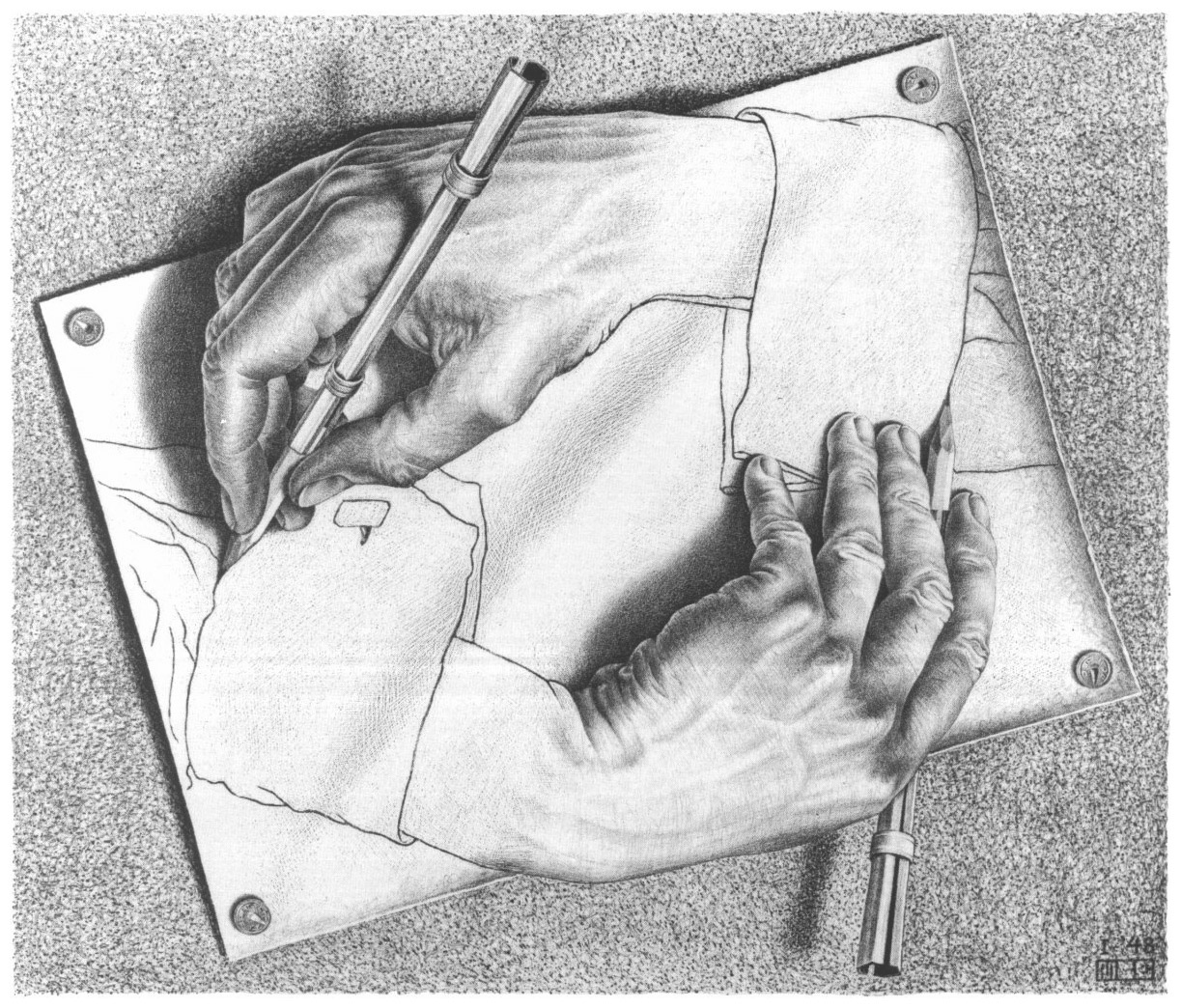
Philosophy, to those who are disdainful of it, is a sucker for a priori sleights of hand: purely logical arguments which do not rely for grip on empirical reality, but purport to explain it all the same: chestnuts like “cogito ergo sum”, from which Descartes concluded a necessary distinction between a non-material soul and the rest of the world.

Douglas Hofstadter is not a philosopher (though he’s friends with one), and in I am a Strange Loop he is mightily disdainful of the discipline and its weakness for cute logical constructions. All of metaphysics is so much bunk, says Hofstadter, and he sets out to demonstrate this using the power of mathematics and in particular the fashionable power of Gödel’s incompleteness theory.

Observers may pause and reflect on an irony at once: Hofstadter’s method - derived a priori from the pure logical structure of mathematics - looks suspiciously like those tricksy metaphysical musings on which he heaps derision. As his book proceeds this irony only sharpens.

But I’m getting ahead of myself, for I started out enjoying this book immensely. Until about halfway I thought I’d award it five stars - but then found it increasingly unconvincing and glib, notably at the point where Hofstadter leaves his (absolutely fascinating) mathematical theorising behind and begins applying it. He believes that from purely logical contortion one may derive a coherent account of consciousness (a purely physical phenomenon) robust enough to bat away any philosophical objections, dualist or otherwise.

Note, with another irony, his industry here: to express the physical parameters of a material thing - a brain - in terms of purely non-material apparatus (a conceptual language). In the early stages, Professor Hofstadter brushes aside reductionist objections to his scheme which is, by definition, an emergent property of, and therefore unobservable in, the interactions of specific nerves and neurons. Yet late in his book he is at great pains to say that that same material thing cannot, by dint of the laws of physics, be pushed around by a non material thing (being a soul), and that configurations of electrons correspond directly to particular conscious states in what seems a rigorously deterministic way (Hofstadter brusquely dismisses conjectures that your red might not be the same as mine). Without warning, in his closing pages, Hofstadter seems to declare himself a behaviourist. Given the excellent and enlightening work of his early chapters, this comes as a surprise and a disappointment to say the least.

Hofstadter’s exposition of Gödel’s theory is excellent and its application in the idea of the “Strange Loop” is fascinating. He spends much of the opening chapters grounding this odd notion, which he says is the key to understanding consciousness as a non-mystical, non-dualistic, scientifically respectable and physically explicable phenomenon. His insight is to root consciousness not in the physical manifestation of the brain, but in the patterns and symbols represented within it. This, I think, is all he needs to establish to win his primary argument, namely that Artificial Intelligence is a valid proposition. But he is obliged to go on because, like Darwin’s Dangerous Idea, the Strange Loop threatens to operate like a universal acid and cut through many cherished and well-established ideas. Alas, some of these ideas seem to be ones Douglas Hofstadter is not quite ready to let go. Scientific realism, for example.

The implication of the Strange Loop, which I don’t think Hofstadter denies, is that a string of symbols, provided it is sufficiently complex (and “loopy”) can be a substrate for a consciousness. That is a Neat Idea (though I’m not persuaded it’s correct: Hofstadter’s support for it is only conceptual, and involves little more than hand-waving and appeals to open-mindedness.
“Perhaps, rather than slamming the door on mysticism, Hofstadter has unwittingly blown it wide open. After all, why stop at human consciousness as a complex system?” 
But all the same, some strange loops began to occur to me here. Perhaps rather than slamming the door on mysticism, Douglas Hofstadter has unwittingly blown it wide open. After all, why stop at human consciousness as a complex system? Conceptually, perhaps, one might be able to construct a string of symbols representing God. Would it even need a substrate? Might the fact that it is conceptually possible mean that God therefore exists?

I am being mendacious, I confess. But herein lie the dangers (or irritations) of tricksy a priori contortions. However, Professor Hofstadter shouldn’t complain: he started it.

Less provocatively, perhaps a community of interacting individuals, like a city - after all, a more complex system than a single one, QED - might also be conscious. Perhaps there are all sorts of consciousnesses which we can’t see precisely because they emerge at a more abstract level than the one we occupy.

This might seem far-fetched, but the leap of faith it requires isn’t materially bigger than the one Hofstadter explicitly requires us to make. He sees the power of Gödel’s insight being that symbolic systems of sufficient complexity (“languages” to you and me) can operate on multiple levels, and if they can be made to reference themselves, the scope for endless fractalising feedback loops is infinite. The same door that opens the way to consciousness seems to let all sorts of less appealing apparitions into the room: God, higher levels of consciousness and sentient pieces of paper bootstrap themselves into existence also.

This seems to be a Strange Loop Too Far, and as a result we find Hofstadter ultimately embracing the reductionism of which he was initially so dismissive, veering violently towards determinism and concluding with a behavioural flourish that there is no consciousness, no free will, and no alternative way of experiencing red. Ultimately he asserts a binary option: unacceptable dualism with all the fairies, spirits, spooks and logical lacunae it implies, or a pretty brutal form of determinist materialism.

There’s yet another irony in all this, for he has repeatedly scorned Bertrand Russell’s failure to see the implications of his own formal language, while apparently making a comparable failure to understand the implications of his own model. Strange Loops allow - guarantee, in fact - multiple meanings via analogy and metaphors, and provide no means of adjudicating between them. They vitiate the idea of transcendental truth which Hofstadter seems suddenly so keen on. The option isn’t binary at all: rather, it’s a silly question.

In essence, all interpretations are metaphorical; even the “literal” ones. Neuroscience, with all its gluons, neurons and so on, is just one more metaphor which we might use to understand an aspect of our world. It will tell us much about the brain, but very little about consciousness, seeing as the two operate on quite different levels of abstraction.

To the extent, therefore, that Douglas Hofstadter concludes that the self is that is an illusion his is a wholly useless conclusion. As he acknowledges, “we” are doomed to “see” the world in terms of “selves”; an a priori sleight-of-hand, no matter how cleverly constructed, which tells us that we’re wrong about that (and that we’re not actually here at all!) does us no good at all. Neurons, gluons and strange loops have their place - in many places this is a fascinating book, after all - but they won’t give us any purchase on this debate.

Friday, 13 January 2012

The hero of a thousand phases

I wrote this the week leading up to the Rugby World Cup Finals. Never quite finished it, but it seems a pity to waste it. Substitute Beaver Donald for Cruden for Slade for Carter, and it wasn't a bad shout!

A hero laid low
It is rugby world cup time. When ace All Black fly-half Daniel Carter was felled by an unexpected groin strain, I wrote to a friend:

I think this is going almost perfectly to the script - literally, the monomyth script, formulated by Joseph Campbell out of thousands indigenous of myths and legends, and used as the basis for many of Hollywood's greatest blockbusters. In it, a callow youth, let us call him Colin, wishes to escape the drudgery of life on the home planet. But then he receives the call ... his at the critical point his talismanic leader is laid low, the team suffer near fatal reverses ...

For my trouble, I was accused of smoking something. Undeterred, I elaborated:  

When, with one minute left on the clock, and six points down, camped on his own try-line, the said callow youth Slade intercepts a carelessly flung pass by a French fly half, glides between two colossal Catalonian oxes, flees like a demon horse over the advantage line, the ten metre line, the half way and surges into the French twenty-two, cuts in towards the posts only to unexpectedly confront the ogre Imanol Harinodoquy (who had been slow to pick himself up out of a ruck on the French 22 in a prior phase, and is accordingly well out of position, but happily for the French is perfectly placed to save the day) and then Slade fleetingly catches a glimpse of his fallen hero Carter, hovering ethereally in the stands, urging him on, and so hardened, with a sublime inside step, a heavenly outside step and then, on the five-metre line, with the great Gallic flanker still miraculously shading him, the most brutal fend ever to be delivered by a flyhalf to a forward, Slade crosses the try line under the posts, and converts his own score to finally return the Rugby World Cup to its permanent home - then you'll understand, my friend.

Maui snares the sun
I based my plot on Joseph Cambell's "monomyth", as revealed in his mighty The Hero With a Thousand Faces - in which Campbell distilled a common heroic storyline underlying the mythologies of hundreds of ancient peoples from Gilgamesh and Agamemnon to the Maori myth of Maui snaring the sun. These days, the monomyth is now pressed into the service of Hollywood screenwriters, but it applies to the drama of sporting conflict as well, as the fanciful passage above illustrates. (Fanciful? substitute Cruden for Slade and it might yet be next Saturday's script!)

Why do men find sporting conflict so compelling? Because it affords us the chance of just such a drama: a compelling morality play but with a grim and irresistable advantage: It is real: uncontrived, there is a real chance that the hero will lose; a good man may die: the elaborately woven narrative of myth may be rent asunder.

Welsh Warrior laid low
We have already seen just such a sequence: an outstanding Welsh Warrior, lain low early in the game by the harshest of Old Testament judgments and sent ringingly from the theatre of conflict.

Yet in their desperate hour his men did not yield, and gave no quarter: Without complaint, without rancour, the remaining warriors regrouped and redoubled their efforts, flew into every tackle, drove their opposition into the ground and nearly - so achingly nearly - pulled off the most heroic upsets of the tournament, losing by a point, and even then half a foot low and half a foot wide.

And so to the New Zealanders. What of their heroic record? Firstly, just look at photographer Mike Hewitt's wonderful image to the right: drink it in, for ten seconds, and try then to persuade yourself that this is a live sports photograph and not a Caravaggio altarpiece. Look at the composition, the heroic lines - the diagonals - the enraptured faces turned towards their quest.

Thursday, 9 June 2011

Evolving Technology

Brian Arthur has trouble seeing where innovation and technological progress fit into the view that the “discovery” phase of Scientific knowledge is all over bar the shouting. 

If the evolutionary account is right, it doesn’t work like that, and we’re the better for it, he says.


B
rian Arthur’s The Nature of Technology is somewhat ponderous in its beginning (and in truth, throughout) but all the same is most encouraging in its epistemological disposition - assuming as it does the recursivity of society and technology, rather than toting the (conventional) view that one is strictly a product of the other. This points you towards a path-dependent model for not just technology, but society and indeed knowledge itself. 

But for some, this is dangerous stuff. It leads in turn to uncomfortable conclusions (at least for the neo-enlightenment brigade) which open the door to all that crazy post-modern stuff. 

Because he doesn’t have to, Arthur doesn’t go there, but he does cast a kindly glance at Thomas Kuhn. (I like people who cast kindly glances at Thomas Kuhn: these days they’re few and far between). 

Arthur doesn’t have to go there (at first) because technology, as implemented, is almost by definition infra-paradigmatic: if “science” is its philosophical principle, technology is its practical implementation - very much the sort of thing Nancy Cartwright would call a “nomological machine”: a construction designed to give a dependable result in a constrained set of circumstances, where the machine not only prescribes the parameters for a “successful” result, but constrains the environment and operating circumstances in which outcomes are generated to ensure the result is within those parameters, and then, reliably, forces that outcome. (A technology that is unable to force an outcome within its own parameters for a successful result is simply a machine that doesn’t work). 

But this leaves a gap. If technology is merely the practical implementation of “normal science”, it has a hard time explaining innovation. As Arthur puts it: 

“Combination [of existing technologies] cannot be the only mechanism behind technology’s evolution. If it were, modern technologies such as radar or magnetic resource imaging ... would be created out of bow-drills and pottery firing techniques, or whatever else we deem to have existed at the start of technological time.” 

If technology is merely the practical implementation of “normal science”, it has a hard time explaining innovation.

The problem, which Arthur specifically sets out to address, is how to account for the “onward” development of technology. Arthur is clear that it is path-dependent (“had we uncovered phenomena over historical times in a different sequence, we would have developed different technologies”) but even this insight, I think, risks undercooking the importance of the narrative conversation: it is not just that combinations of technologies through time let us further uncover existing theories and give us better and more powerful and enabling answers to our original questions; they prompt completely new questions: they afford new ways of looking at the world. New ways of looking generate new opportunities, and new problems. 

This is a significant point. 

For example: prior to the digital age, categorisation of information was a difficult and inherently limited (and, actually, biased) thing: the physical nature of information storage (books) dictated a single taxonomy and a single hierarchy, and required commitment to a single filing taxonomy (without owning more than one copy of a book, you can’t file it in two places). Digitisation changed that forever: the Dewey Decimal system - brilliant in its design though it undoubtedly was - solves a problem we no longer have, but at the cost of forcing our hand in a way we no longer need. Digital technology has enabled us to entirely re-evaluate what information really is. 

As he goes on, Arthur explicitly keeps in mind two “side issues” that constantly recur in writings about technology: the analogy to Darwin’s program of evolution, on one hand, and the analogy to Kuhn’s theories of scientific revolution on the other. But these are, to my mind, different articulations of the same idea: that “questions” and “answers” (whether you characterise these as “environmental features” and “biological adaptations which evolve to deal with them”, or “observational conundrums” and “scientific theories which purport to explain them”) are, to a large extent, interdependent: something is only a conundrum if it appears to contradict the prevailing group of theories. What both Darwin and Kuhn suggest is that “linear progress” - insofar as it implies a predetermined goal to which an evolutionary algorithm is progressing - is a misconceived idea. Evolutionary development is better characterised as a move away from the status quo, rather than a move towards anything (in hindsight, both will seem the same; to confuse them is a fundamental error).

Yet, and while Arthur clearly recognises this, he does continue to frame his explanatory theory in terms of “forward progress”, as if that is the “conundrum” to be solved. The thing is, even our traditional conception of it has this the wrong way round: “the invention of the jet engine” wasn’t what was going on; it was “the invention of a way to fly in thinner air”. The jet engine was the first solution arrived at that met that purpose (as, in a totally different context, Richard Susskind elegantly points out, when you shop for a Black & Decker, it isn’t a drill you want; it’s a hole). Technology (and science, and biology) isn’t an end, it’s a means. The more means you have, the more ends are available to you. 
The implications of this are striking. They completely undermine the idea of technology as a “forwardly moving” phenomenon. 

I had therefore wondered whether Arthur had missed a trick in his account of technology - the fact that any novel solution to an old problem creates new questions that we did not think - or need - to ask previously. But as his book closes and he views technology through the prism of the economy (on his theory the two are independent; the former is not merely the handmaiden of the latter), he nails this, too: 

“The coming of novel technologies does not just disrupt the status quo by finding new combinations that are better versions of the goods and methods we use. It sets up a train of technological accommodations and of new problems, and in doing so it creates new opportunity niches that call forth fresh combinations which in turn introduce further technologies - and further problems.” 

The implications of this are striking. They completely undermine the idea of technology as a “forwardly moving” phenomenon. It recalibrates to our changing needs and perceptions, just as we recalibrate to the changing perspectives and vistas it affords us. That is a million miles away from Ray Kurzweil’s carefully plotted (and in your correspondent’s opinion, absurd) logarithmic charts of technological progress that will see machines - and, on Kurzweil’s account, eventually the cosmos itself - “wake up”. 

Even if there were no other reasons (and there are many), one reason for favouring Arthur’s less ambitious (but actually more radical) view is its humanity. Arthur closes the book with a neat bit of lit crit: the forces of good and evil in Star Wars, he observes, can be differentiated by their relationship with technology: the Empire’s clinical, cold, efficient, androidal heartlessness - against the temperamental, jury rigged, cantankerous and fallible technology of the rebels: in one case technology is our weapon: it relies on us, on our skill, on our judgment and our humanity: we are the necessary homunculus; in the other the humans are, more or less, the “necessary evil” - the impediment to the technology achieving its ends.
Recognising that the special sauce in technology is, for the time being at least, the bit supplied by the meatware, is a comforting thought.


Monday, 13 December 2010

The vampire at the spring, and beneath the Apple Tree - წინწყარო

Nosferatu: The Vampyre/Phantom Der Nacht (2 Disc Set)Apropos nothing, except the burning need to share this. Here is cinema and music combined in the most haunting of ways.

The film is Werner Herzog's 1979 Nosferatu, Phantom der Nacht, itself a remake of FW Murnau's silent classic Nosferatu, Ein Symphonie des Grauens.

The music is a Georgian Folksong, spelled variously Tsintskaro/Tsintsqaro/Zinzkaro/Winwyaro, which means "at the spring", and it is performed by the Georgian vocal ensemble Gordela.

The lyrics translate as:

I was passing by the spring.
There I met a beautiful woman with a jug on her shoulder.
I spoke a word to her and she left, offended.
I was passing by the spring.

The juxtaposition of this scene, in which Isabelle Adjani walks in disbelief through a town square where plague-infected locals engage in final, silent, danse macabre to the accompaniment of this extraordinary music is one of the most haunting scenes in all of motion picture history.

Hamlet GonashviliThe music is hard to track down, but with the internet it's possible: Hamlet Gonashvili, until his death one of the most influential teacher and performer of traditional Georgian music, has a recording which is now available on Amazon.

Wikipedia records that Gonashvili died in 1985, at the height of his fame, as the result of a fall from an apple tree, which somehow fits with the song, and indeed Herzog's scene, with its implications of the fall of man and a loss of innocence!

Here is a link to a poorly copied rendition of the scene on YouTube.
The original Nosferatu is public domain, and you can watch the whole thing on Youtube if you like (but do yourself a favour, and get a DVD).

Sunday, 17 October 2010

Passionsspiele 2010


The Ammergau Mountains lie an hour south of Munich and form a verdant prelude to the Bavarian Alps. Amongst them, in a deep valley, nestles the mediaeval village of Oberammergau. On a hot summer’s day storms can form quickly out of the clear blue sky: sunbeams scatter and burst from behind darkening nimbi, and majestic thunderheaded anvils roil behind the iron cross high on Kofel, the rocky spire that dominates the village. Even nowadays it doesn’t take much imagination to apprehend the Almighty near at hand.

If it feels that way today, it must have seemed all the more like it in the seventeenth century. In 1633, the villagers of Oberammergau faced dark times. Black Death was sweeping the continent, visiting even the sleepiest backwaters of Bavaria. The Burghers of Oberammergau assembled in their Lord’s house and prayed for deliverance. They proposed a deal: spare our village from this plague now and, for the hereafter, it will glory your name by performing a passion-play, once a decade.

From that day, so legend has it, no further lives were lost and, ever since, the locals have kept their side of the bargain (with some additional centenaries thrown in, and the odd war years skipped), and 2010 sees the forty-first production of the “Passionsspiele”. As per the original sacred covenant, the production remains entirely local: to be even a stage-hand you must have been born in the village or lived in it for at least twenty years.

That’s the story, and it has been handed down, embellished and retreaded through the centuries to the point where it is certified folklore, and those of its oddities which don’t bear close examination generally don’t get it. It isn’t sporting to ask questions like, why only once a decade? Does the bargain not seem a pragmatic, faithless and rather un-Christian compromise? What would happen if the villagers stopped doing the play? Would an avenging cloak of Black Death envelope the town?

In any case, times move on. At some point the imposition represented by the covenant was eclipsed by the commercial opportunity it presented, and you fancy that, these days, they’d stage the play whether or not they feared a plague on their houses. For every ten years Christians and fellow travellers from around the world make the pilgrimage to Oberammergau in their hundreds of thousands. Jerome K. Jerome wrote a
droll account of his journey in 1890. Cardinal Ratzinger (as he then was) visited in 1980. And a certain German chancellor, best not mentioned these days, visited and declared himself very satisfied with the play’s reflection of his own vision for the good people of Germany (not to mention those of Jerusalem) in 1934.
But Oberammergau is by no means just for the great and (or) good or devout: My mother (a curious but un-energetic Presbyterian from Auckland) visited in 1960 as a twenty-two-year-old, returned again twenty years later with my father (an equally unenthusiastic Anglican), and returned thirty years later still, this summer, with her son and his wife (both enthusiastically none of the above).

Undeniably, there is something very special about the place and the play. To be sure: this is no church hall nativity nightmare of amateur dramatics: Nearly all of the townsfolk are involved in the production in some capacity or other; the cast numbers in the hundreds and features real donkeys, sheep, horses, camels and poultry, a full orchestra and fifty-strong choir. Oberammergau’s men abstain from shaving and cutting their hair for a year leading up to the performances. The dedicated theatre seats 5,000 and is rammed, five nights a week, continuously for five months of the season in any weather (until 2010 the stage was open-air; now it has a retractable roof), and each performance, not counting a three-hour meal break, lasts five and a half hours. It’s in German, but has a solemnity and magnificence of scope which transcends the language barrier (and with a translation of the script to hand, it’s not that much of a barrier in any case).

Over its season Oberammergau welcomes upwards of half a million visitors. To cope with the proverbial “dramatic influx”, the locals open their houses to visitors.


And here, too, it seemed to us that the Almighty might be taking an interest. In 1960 my mother was billeted with Benedikt Stükl, cast as Caiaphas, the high-priest (his son Peter being in the chorus). Twenty years later, on her return she stayed, quite by chance, with the same family, Benedikt now having been elevated to play Annas, the elder priest of the High Council and Peter, with a teenage daughter of his own in the choir, now playing Caiaphas. This year, again quite by chance, we found ourselves staying with same family again. This time Peter’s daughter, now 47, was running the Gasthof and appearing with her own children in the chorus, her brother Christian directed the play, father Peter was a white-bearded Annas, and grandfather Benedikt is now (one hopes, having portrayed the villain so many times) in an altogether better place.

Oberammergau, and its passion play, pose questions for the Bavarians and their way of life: maintaining a four-hundred year-old tradition participation in which is limited to village lifers, is a symbol of the conservatism and insularity for which the locals are notorious. The demographic of the hordes that flock to see the play is singular: they’re mostly German and in the latter half of life; they’re generally well-to-do, and they’re absolutely all white. This much is characteristic of the region which is stunningly beautiful, well-tended and maintained: to preserve those surrounds, attitudes require buildings (and, on a Sunday, dress) to conform to styles a hundred or more years old, defiantly despiting Anglo-Saxon sniggers at grown men in leather shorts. There is little appetite here for modernity, and while this makes for a refreshing, stunning, peaceful escape from the city, you fancy the cost for the young folk is a stultifying and oppressive existence. There’s an undeniable tweeness about the place.

Yet curiously not a hint of tweeness makes it into the production itself. It is stylish, grave, emotional and, in its current iteration, modern. It also conveys entirely the strong community bond of the village. When the play opens with Jesus’ triumphant entry to Jerusalem on Palm Sunday, and the full cast, from grandparents down to a three month old baby, you get a real sense of this being a presentation of the whole community. When a mother in the crowd reins in her errant children, you know these really are their own children, and she really is reining them in.

The orchestra, choir and the music were consistently impressive: without being an expert I would put the music in the German style of a Mozart mass – possibly not as histrionic, and it was dealt with serenely by the orchestra and a large choir dressed in androgynous ankle-length smocks with headdresses which invoke Virgil when accompanying Dante in his divine comedy. The sight of these nearly fifty angelic beings arrayed across the massive stage was striking and solemn.

While this might be still a most conservative Catholic Christian town, the 2010 production, in a gentle way, has its revolutionary aspects. Jesus is portrayed as a political revolutionary and not, even remotely, as a supernatural being. The scriptwriters have taken some notice of recent cause célèbres of Christian revisionism: There’s a hint – though nothing more – of a “thing” between Jesus and Mary Magdalene. Post Dan Brown this seems an almost orthodox idea, but would have been sacrilege even thirty years ago.

Yet, Jesus’ aim is still the conservative one of returning to the literal word of God; he casts aside the pragmatic accommodations that Caiaphas and his coterie have tolerated such as the money-changers in the temple. In a way, this is as conservative a reading as you could ask for. Here the Passionplay’s famous “tableaux vivants” – living still lives, interposed with the acts of the production – add to dramatic punch, and tie in this “progressive” aspect to the tradition from which the revolutionary New Testament sprang: the Old Testament itself. Of course, one has to be selective to find Old Testament tableaux which are consonant with any reading of the New Testament, but the producers have been careful, and the tableaux do make a point. Lord only knows, the money-changers have been running riot since Oberammergau last staged its play, and in its way the values this event represents, both explicitly through its message and through its very existence at all, stand as a bulwark against our commercial predilections.

Nonetheless, modernity, as with all compromises, has its price. The jettisoning of the mystical might appeal to the contemporary secular (not many of whom were in evidence in the crowd), but the play lacked a little of the “spiritual” wonder which sets Jesus’ story alight in the first place. Reduced to low political intrigue, the Passionsspiele omits something important. The Sanhedrin’s human motivations might drive the narrative, but they’re not what makes it special.

In its eagerness cater for modern pluralism and to give a better account of the Jewishness of the story, the production redeems Judas a step too far: in the first act he is the dominant and most fervent disciple – shading even Peter and Simon, who usually fill that role. Later, even when his commitment wavers, he has to be tricked by Caiaphas into betraying Jesus, and when he realises what he has done, he tries directly to undo it, producing the most public and defiant defence of the arrested Jesus from any of the disciples. Indeed, the “redeemed Judas” resembled the one from C.K. Stead’s recent novel “My Name Was Judas
”. Peter, meanwhile, denies all knowledge, as we know he must, but when he is thereby outdone in his fidelity by the traitor, someone’s got their theological wires crossed.

In his time of death, Judas even outdoes Jesus. Wracked with remorse, Judas soliloquises earnestly and lengthily before hanging himself. By contrast Jesus says very little in his second act, whilst Caiaphas, Nicodemus, Pilate and others trade voluble insults without really achieving anything.

The resurrection is handled quickly, and again somewhat secularly: Jesus does make a final appearance, silently - but it’s more in the nature of a pre-close curtain call than an inspirational visitation, and as the cast and choir finally file off the stage at the conclusion, all that remains to receive the applause was a flickering flame.

As the applause dwindled, the house lights came up, and the massive theatre emptied. No curtain call: that sort of triumphalism would be to miss the point. And as we stepped out into the crisp evening, some eight and a half hours after it had started, the almighty again seemed near at hand: the universe twinkled down on this deep mountain valley, and mighty platinum clouds fringed a gibbous moon.

Sunday, 13 June 2010

How to philosophise with a hammer

I am a hopeless handyman. I have poor attention to detail and lack patience. I am disorganised. When hanging a picture, rather than finding a hammer, I bash the tack in with whatever first comes to hand. Recent examples: A tin of Rawleigh's Medicated Ointment (reasonably effective), an ornamental porcelain donkey (bad - it didn't survive) and a book (a hard-backed edition of E. O. Wilson's Consilience: better than nothing, but now pocked with pinholes).


That we tend to do that sort of thing lies at the root of a big problem with the ideas inside Professor Wilson's book (just as well, therefore, it has some use for hammering in picture hooks). Using a familiar object to do an unfamiliar job is rather like coining a metaphor: It's a creative act. As well as being pragmatic, it has its advantages. (It must have some advantages - convenience; it overcomes the lack of botheredness to find the hammer - or you wouldn't do it). But while my tin of ointment (or ornamental donkey, for that matter)  might not be conventional (and, in the donkey's case, might not work awfully well) it's not wrong. It is as good as the job it does. A "proper" tack hammer has been designed, to the exclusion of all other purposes, for hammering in tacks. You can imagine other objects being better or worse at functioning like hammers. Blu-tack, for example, would be hopeless. But not wrong. Just not much use.

And so it is with metaphors:  they deliberately take a conventional concept and put it to work in a concept it wasn't designed for. As a result metaphorical meanings are different from literal meanings (in a manner of speaking) but no worse or better - while they might be more or less effective, effectiveness is in the eye of the beholder.

Often, a metaphor can more elegantly or succinctly some aspects of its "target" (which Julian Jaynes would call a "metaphrand") than a literal construction. "Love is a rose": I suppose you might take this to mean love is a delicate, beautiful, fragile, thing that can prick you if you aren't careful with it. Or that is is a soft, rich and complexly enfolded collection of different facets. These aren't mutually exclusive metaphors, but they're not entirely consistent either. Both of them make some sense, where a literal interpretation of "love is a rose" doesn't.

Now while I was bashing in my picture hook with Professor Wilson's book I got to thinking about what was inside his book, and how Professor Wilson's whole enterprise, his desired end state, is one which overlooks the metaphor. This is some irony as metaphors, and rich ones at that, are scattered prodigally around his text.

Professor Wilson, in Consilience, sees the possibility (not yet arrived) of a unified, unique, continuous, contiguous spectrum of knowledge, encompassing not merely the physics and the physical sciences, but all of the humanities too. In fact, I think he sees the necessity of it. Wilson is an unabashed reductionist. Wilson embraces a hierarchy of physical sciences (physics at the bottom, grounding everything else; Chemistry sitting atop it, Biology atop that, and so on. Higher sciences can be reduced to lower ones; all sciences are consistent with each other, and it is only a lack of data which prevents completion of the total blueprint of the physical universe. Thereafter the social sciences and even the arts will fall into a pre-ordained and logical place and will similarly be logical, consistent and unambiguously explicable. Wilson is excited by this idea (it horrifies me, personally), and sets out in his book to give it some intellectual underpinning.

Wilson is running before he can walk. Metaphor gets in the way - literally, and metaphorically. The same thing happened to Bertrand Russell following a similarly hubristic exercise restricted to the logical underpinnings of mathematics. In the infancy of the twentieth century Russell tried to chart the entirely cosmos of the mathematical universe by reference to a single, finite set of well-defined logical axioms. By limiting himself to numbers, Russell took up an easier challenge, you would think, than Wilson has. Mathematics was, Russell supposed, a closed logical system: finite, reducible and therefore well susceptible to his kind of enterprise.

But Russell failed to complete his mathematical globe. Russell didn't just not manage to get to all points in a large whole; he failed totally: his entire project, so pointed out a precocious young German chap by the name of Goedel, was logically flawed. Doomed.

The reason? Metaphor. Even though Russell had decreed some ad-hoc rules to guard against logical cul-de-sacs - for example, no item was allowed to be a member of its own set - it was possible to run mathematical operations by analogy - metaphorically, in other words, that could tell you things that a literal mathematical operation could not. And any ostensibly complete description of a language which forbade expressions such as "the set of all possible sets" was going to be practically useless anyway. There are some excellent accounts of Goedel's dramatic insight, Douglas Hofstadter's a particularly good one (though his ultimate conclusion seems wildly wrong).

When he does refer to metaphor, Wilson's is a rather unimaginative account: what he describes isn't metaphor so much as definitional drift occasioned by metaphor. To use one of his examples, by the time "plot" - a physical site and a building plan - came to mean "plot" - the narrative structure of a story - any figurative content in the expression had long since evaporated; seawater gone, a residue of salt.

Wilson's idea of a metaphor therefore is a dead one: these are the ones "normal scientists" like, of course, because dead metaphors can't get up and bite you by suggesting what you meant to say might be taken in a number of ways. If there were a substantive distinction between art and scientific literature - and like Wilson, but for radically different reasons, I'm inclined to think there isn't one - it might be found in the systematic exclusion of metaphor from scientific discourse. Science is about exactitude; consensus on a literal way of speaking enhances that end.

But at some cost, and not just in the notorious dullness of scientific literature. Literalness encourages and perhaps compels compliance with orthodoxy. Paul Feyerabend - another conspicuous absentee from Wilson's reading list - makes the inspired observation that scientific revolutions rely on inspired observations: a willingness to disregard the formal language of the discipline. If you stick rigidly to the rules of the prevailing scientific paradigm it is not possible to see, much less formulate, contradictions to it: Anything which looks like a contradiction, by the terms of the theory, must be explicable some other way (wind interference; malfunctioning equipment).

To find a new solution to a conundrum you are forced to use existing concepts in a new way. You can only do it by being creative with your language.

Monday, 31 May 2010

The Blues had a baby and they called him Virgil McMahon

A skinny kid in new sneakers grabs a '62 Strat by the neck and takes the stage. The boy rejoices in the name Virgil. Without ado he tears out a bang-on version scuttle buttin', the paint-blistering opener of Stevie Ray Vaughan's  Couldn't Stand The Weather. Paint duly blisters.

Bang-on. A little dirtier, maybe - but he's just a kid- he's got testosterone to cope with and all, and he did call his band The Accelerators. They don't claim subtlety; don't expect it. Before the end of his set he's done the same album's title track too, the same way. Foot down hard against the metal. "Floor it - that's technical talk", just like Stevie says.

Technical Talk. Virgil's 18. Virgil's from Aberystwyth. Virgil totes a '62 Strat. Before you ask how he came by an axe the rest of us would take out a mortgage for, he tells you: Virgil's an arms dealer. Virgil traded it for guns and diamonds. Or his daddy did. Or I misheard. it was loud in the club.

Virgil's from Aberystwyth. A big market for contraband arms in the Welsh valleys, then? Virgil tells you he's an African. Or his daddy is. Or they both are, and so's his kid brother. Virgil leans back and gestures at the kid on the drums. Virgil's brother is 16. Traded them for an Uzi. Or his daddy did. Or something.

Who's the daddy?

Stevie Ray Vaughan is.

Virgil tells you, earnestly, that he doesn't want to be another Stevie Ray, that he wants to be the original Virgil McMahon, and then he shows you his tattoo. It don't say "Virgil". And nor - yet - does his guitar playing.

They both say "SRV". In capitals.

Now, of course, that's no bad thing for now. There was another hot guitarist in town, back end of last week. Virgil left him for dead. There's an argument, matter of fact, this other dude was dead. If he wasn't, Virgil's got chops this other guy would die for. This other guy used to be a contender. Eric someone.

Read it: Virgil left Clapton for dead.

Read it: Virgil's just a kid. Sap rising, mojo working.

Read it: Virgil's mama told him he's gonna be the greatest man alive. Virgil just doesn't know this yet, because he hasn't discovered Muddy Waters yet.

He'll learn - and then, by God, then he'll play the blues.

But for now he needs to work out what numbers up to 5 on his gain dial are for, and to look out some of the other records in his daddy's collection besides Texas Flood.